
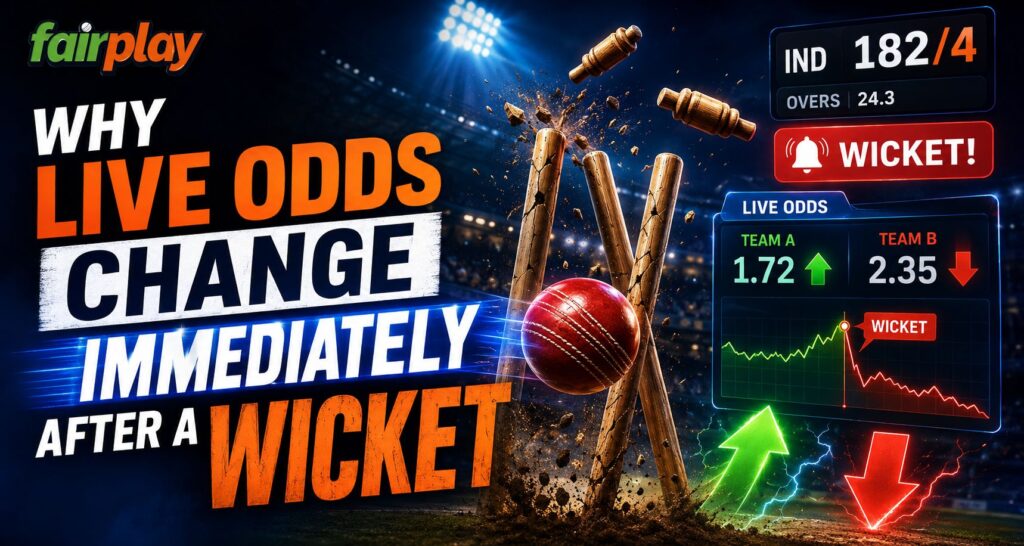
In live cricket markets, few moments affect the numbers as quickly as a wicket. A dismissal can instantly change the expected direction of a match because it removes a batter, brings a new player to the crease, and often changes the required scoring pattern. For users following live cricket through Fairplay24, understanding why odds react so fast after a wicket can make market movements easier to interpret. The change is usually based on updated match probabilities rather than the wicket alone.
Why Is a Wicket So Important to Live Odds?
A wicket reduces the batting team’s available resources. In limited-overs cricket, teams have a fixed number of overs and wickets, so losing one immediately changes the balance between runs needed and players remaining.
Live pricing systems typically consider factors such as:
- Current score
- Overs remaining
- Wickets lost
- Required run rate
- Strength of the dismissed batter
- Quality of the incoming batter
- Pitch conditions
- Match format
This information is updated almost immediately, which is why the odds may move within seconds.
The Value of the Batter Matters
Not every wicket has the same effect.
If a lower-order batter is dismissed near the end of an innings, the market reaction may be relatively small. However, if a well-set top-order batter is removed during a difficult chase, the movement can be much more noticeable.
For example, a batter on 75 from 50 balls may already be comfortable with the pitch and bowling attack. Replacing that player with someone new creates additional uncertainty.
Users checking cricket markets after a Fairplay24 in Login may notice that the identity of the dismissed player can matter almost as much as the wicket itself.
A New Batter Needs Time to Adjust
A new batter usually enters without having faced the current bowling conditions.
They may need time to understand:
- Pace of the pitch
- Amount of spin
- Bounce
- Bowling lengths
- Boundary dimensions
- Match pressure
This adjustment period can temporarily reduce the batting team’s expected scoring rate.
In a T20 chase, even three or four quiet deliveries can increase pressure significantly. That is one reason the odds can move sharply after a wicket late in the innings.
Required Run Rate Can Rise Immediately
A wicket often affects more than personnel. It can also slow the scoring rate.
Consider a team needing 60 runs from 36 balls. If a wicket falls and the next over produces only three runs, the required run rate becomes more demanding.
That creates a chain reaction:
- A key batter is dismissed.
- A new batter takes time to settle.
- Fewer runs are scored.
- Required run rate increases.
- The batting side must take greater risks.
- Live probabilities adjust again.
On the Fairplay24 App, users may therefore see several small movements following one wicket rather than just a single change.
Wickets Have Greater Impact at Certain Stages
The timing of a dismissal is crucial.
Early Innings
An early wicket can expose the middle order sooner than expected, but there may still be enough overs to recover.
Middle Overs
A wicket during a rebuilding partnership can interrupt momentum and change the planned acceleration point.
Death Overs
Late wickets can have the biggest immediate effect because there is almost no time for recovery.
A team chasing 25 from 12 balls may look well positioned with a set batter at the crease. If that batter is dismissed, the market can shift dramatically because a new player must immediately attack.
Match Format Changes the Reaction
A wicket in T20 cricket generally creates a sharper short-term reaction than the same wicket in a 50-over match.
T20 teams have fewer deliveries available, meaning each wicket represents a larger portion of their remaining resources.
In ODIs, the batting side may have enough time to rebuild after losing a player. This makes the impact more dependent on the score, match stage and batting depth.
For anyone following live analysis through Fairplay Com, the format should always be considered before interpreting a sudden odds movement.
Batting Depth Can Reduce the Impact
Markets also consider who is still available to bat.
If a team has several strong batters remaining, one wicket may cause only a moderate change. If the dismissal exposes inexperienced lower-order players, the reaction can be much stronger.
Important considerations include:
- Number of recognized batters remaining
- Current partnership
- All-rounders in the lineup
- Quality of the tail
- Match situation
This is why two teams losing their fifth wicket at the same score can still produce very different live-market reactions.
Bowler and Pitch Conditions Also Matter
The wicket itself may indicate that conditions are becoming harder for batting.
For example, if a spinner takes two wickets in quick succession on a turning pitch, the market may begin to expect more dismissals.
Similarly, a fast bowler generating swing under lights can increase the perceived risk for incoming batters.
Live odds therefore respond not only to what just happened, but also to what that event suggests may happen next.
Why Odds Can Move Again After the Next Few Balls
The first reaction after a wicket is not always the final one.
If the incoming batter immediately hits a boundary, the odds may move back. If the new player struggles to score or another wicket falls, the movement may continue in the opposite direction.
This continuous adjustment is a key feature of live markets.
Conclusion
Live odds change immediately after a wicket because a dismissal alters the batting team’s resources, scoring potential and future match probability. The size of the movement depends on who was dismissed, when the wicket fell, the required run rate, batting depth and match conditions.
Understanding these factors helps explain why one wicket may cause only a small adjustment while another can completely change the direction of a live market.
Frequently Asked Questions
Why do live odds move instantly after a wicket?
A wicket changes the expected chances of each team because one batter is removed and a new player must enter under different match pressure.
Does every wicket cause the same odds movement?
No. The reaction depends on the importance of the batter, match stage, wickets remaining and strength of the players still to come.
Why are late wickets more important in T20 cricket?
There are fewer deliveries remaining, so the batting team has less time to recover after losing a set batter.
Can odds move back after a wicket?
Yes. If the incoming batter scores quickly or forms a strong partnership, the market can adjust again.
Does batting depth affect live odds?
Yes. Teams with several capable batters remaining may be viewed more positively than teams whose lower order is already exposed.
Do pitch conditions influence the reaction after a wicket?
Yes. A wicket on a difficult or deteriorating surface can suggest that additional dismissals are more likely, which can affect market expectations.