
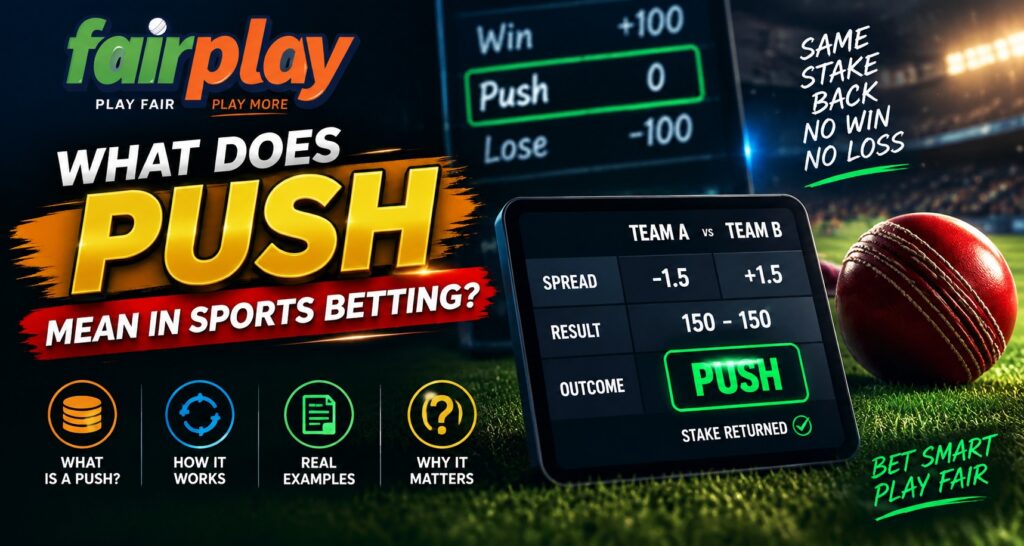
Sports betting includes many terms that beginners may find confusing, and “push” is one of the most important concepts to understand. On Fairplay24, users following different sports markets may come across situations where the final result does not produce either a win or a loss. Instead, the wager may be settled as a push, meaning the original stake is returned according to the market rules.
Understanding how pushes work can help beginners read betting outcomes more clearly and avoid confusion when reviewing settled wagers.
What Is a Push in Sports Betting?
A push occurs when the final result exactly matches the betting line or condition set for a market.
In simple terms:
- The selection does not win
- The selection does not lose
- The original stake is returned
- No profit or loss is recorded
For example, if a basketball team is given a handicap line of exactly 5 points and finishes the match with that exact difference, the wager may be considered a push depending on the market rules.
After completing a Fairplay24 in Login, users can review settled bets to understand whether a wager has been marked as a win, loss, or push.
Why Do Pushes Happen?
Sportsbooks and betting markets often use lines designed to create balanced opportunities between outcomes.
Examples include:
- Point spreads
- Handicap markets
- Total goals or runs markets
- Exact score-related conditions
- Other number-based markets
When the final result lands exactly on the listed number, there is no advantage for either side.
This is why the bet is returned rather than classified as successful or unsuccessful.
Push Example in a Handicap Market
Imagine a cricket match where a team is given a handicap of -20 runs.
The adjusted result depends on the handicap calculation.
If the team finishes with exactly the required difference after applying the handicap, the market may result in a push.
The user does not receive winnings, but the original stake is returned.
Someone using the Fairplay24 App should always check the specific market rules because settlement conditions can vary between sports and bet types.
Push Example in Total Points or Runs Markets
Pushes can also happen in over/under markets.
Suppose a football match total is set at exactly 3 goals.
Possible outcomes:
- Match ends with 4 goals → Over wins
- Match ends with 2 goals → Under wins
- Match ends with exactly 3 goals → Push (if the market rules allow)
The final number matching the line creates the neutral result.
Push vs Win vs Loss
The easiest way to understand a push is to compare it with other outcomes.
| Result | Meaning |
| Win | The selected outcome beats the market condition |
| Loss | The selected outcome fails to meet the condition |
| Push | The result exactly matches the betting line |
A push is different from losing because the user’s stake is generally returned rather than lost.
Does Every Bet Type Allow Push Outcomes?
No. Push outcomes are mainly associated with markets where a specific number or line is involved.
They are more common in:
- Handicap markets
- Spread markets
- Over/under totals
- Some special number-based markets
Traditional winner markets often do not produce pushes because there is usually a clear winning and losing outcome.
For example, a team either wins or loses a match-result market. A draw or tie may have separate rules depending on the sport and market type.
What Happens to Your Money After a Push?
When a wager is settled as a push, the original stake is usually returned to the user’s balance.
For example:
- Stake placed: ₹1,000
- Result: Push
- Returned amount: ₹1,000
There is usually no additional profit because the market condition was not beaten.
Users checking their account through Fairplay24 Com should review the settlement details shown for the specific wager.
Why Beginners Should Understand Push Rules
Knowing push rules Helps users avoid misunderstandings when checking bet results.
Without understanding the concept, a beginner may wonder:
- Why was my bet not marked as a win?
- Why did I receive my money back?
- Why was there no profit?
- Why did the market not show a loss?
Understanding settlement terms makes betting records easier to interpret.
Common Mistakes About Push Bets
Beginners often misunderstand pushes in several ways.
Common mistakes include:
- Thinking a push is a small win
- Assuming returned money means profit
- Ignoring market-specific rules
- Confusing pushes with voided bets
- Not checking handicap calculations
Each market has specific settlement conditions, so reading the rules before participating is important.
Push vs Void Bet: Are They the Same?
A push and a void bet are different.
A push happens because the final result exactly matches the market line.
A void bet usually occurs because the wager is cancelled due to specific conditions, such as:
- Event cancellation
- Market rules not being met
- Incorrect listing
- Other settlement conditions
Both may result in the stake being returned, but the reason behind the settlement is different.
How to Check Push Settlements
Users can review settled wagers by checking their betting history.
Important details include:
- Market type
- Selected outcome
- Final result
- Settlement status
- Returned stake
- Applicable rules
A clear understanding of these details helps users track their activity more accurately.
Why Push Rules Improve Market Balance
Push outcomes help create fairer markets by preventing situations where a tiny difference decides the entire result.
They provide a neutral settlement option when the final outcome exactly matches the prediction line.
For users exploring sports markets, understanding terms like push, void, win, and loss is an important part of learning how settlements work.
FAQs
What does push mean in sports betting?
A push means the final result exactly matches the betting line, so the wager is usually returned without profit or loss.
Do I lose money on a push bet?
No. In most cases, the original stake is returned when a bet is settled as a push.
Is a push the same as a win?
No. A push is a neutral result where the wager does not produce either profit or loss.
Which betting markets commonly have pushes?
Pushes are common in handicap, spread, and total points or runs markets.
Can every sports bet end in a push?
No. Pushes mainly occur in markets involving specific numbers or lines.
Why should beginners understand push rules?
Understanding push rules helps users correctly interpret bet settlements and avoid confusion about returned stakes.