
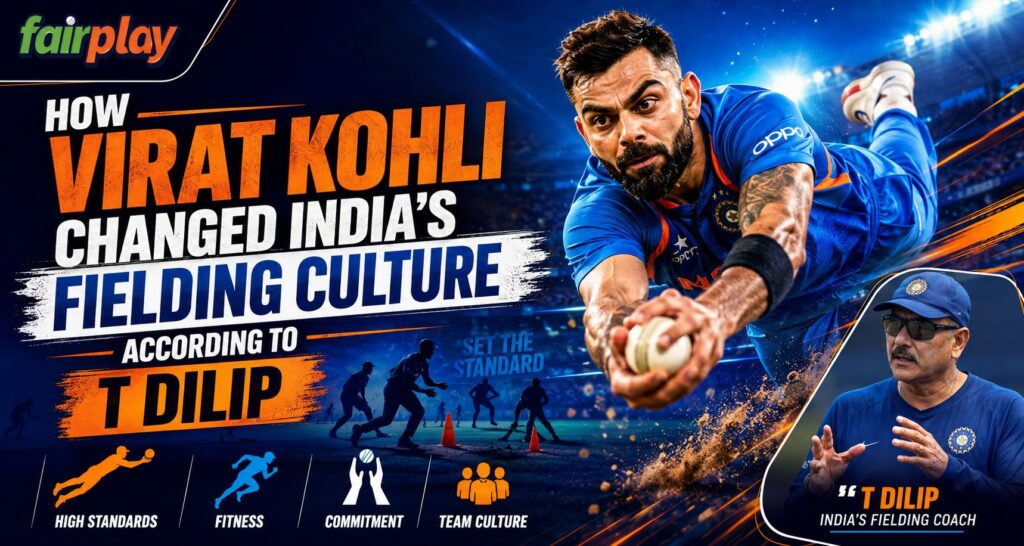
Virat Kohli’s impact on Indian cricket extends far beyond batting records and captaincy. His fitness, energy and commitment in the field helped create expectations that every run saved should matter. For followers of Indian cricket through Fairplay24, former India fielding coach T Dilip’s latest comments explain why Kohli became such an influential figure in changing the team’s approach to fielding. According to Dilip, Kohli’s intensity remains constant whether he is training or playing an international match.
Kohli Made Intensity a Daily Standard
Dilip has repeatedly highlighted one characteristic that separates Kohli from many players: his intensity does not disappear during practice.
He explained previously that there is very little difference between the way Kohli fields in training and the way he approaches a competitive match. That attitude means diving, backing up throws and attacking the ball are practised as genuine match skills rather than treated as optional extras.
The approach includes:
- Training with match-like commitment
- Sprinting even when the ball is away
- Backing up teammates consistently
- Attacking possible run-out opportunities
- Treating every saved run as valuable
For users following cricket conversations through Fairplay24 in Login, this is an important part of Kohli’s influence that basic statistics cannot fully capture.
How Kohli Influenced His Teammates
According to Dilip, Kohli does more than complete his own fielding responsibilities. His energy encourages players around him to increase their effort as well.
Dilip said during India’s 2024 series against Afghanistan that Kohli’s intensity inspires others and challenged younger players to reproduce even part of the effort he brings. Kohli was subsequently recognised as India’s Best Fielder of the Series after producing several memorable contributions.
That influence helped establish several expectations within India’s fielding unit:
- Senior players must lead through effort
- Reputation should not reduce fielding responsibility
- Every player should contribute away from the ball
- Fitness must translate into match impact
- Younger players should compete for difficult fielding positions
Followers checking Fairplay24 App updates can therefore see why Kohli’s impact cannot be reduced to catches alone.
Fitness Changed What India Expected From Senior Players
Traditionally, senior batters can sometimes move towards less demanding fielding positions as their careers progress.
Kohli challenged that idea by continuing to field in physically demanding areas, including the covers, mid-wicket and boundary. Dilip has specifically praised his willingness to save runs, dive and place himself in important positions rather than simply seeking an easier fielding role.
His example helped connect physical conditioning directly with fielding performance.
For Fairplay24 Com readers, that is perhaps one of the most important cultural shifts. Fitness became useful not simply because a player could pass a physical test, but because it allowed India to maintain intensity throughout long innings.
The Best Fielder Medal Strengthened the Culture
Dilip also helped reinforce India’s growing focus on fielding through the Best Fielder medal.
During the 2023 ODI World Cup, he explained that the award was designed to recognise much more than spectacular catches. Runs saved, effort, attitude, consistency and overall value to the team were also considered. The concept had actually begun several months before the World Cup.
That philosophy matched Kohli’s style perfectly.
A fielder might not take a catch during an innings but could still influence the game through:
- Saving boundaries
- Preventing easy singles
- Accurate throws
- Supporting other fielders
- Maintaining pressure for 50 overs
For users accessing Fairplay24 in Login, this broader definition helps explain how India’s fielding culture became more focused on collective effort.
Kohli’s Practice Habits Became Part of His Leadership
Even when Kohli was no longer captain, his habits continued to provide leadership through example.
Dilip’s latest remarks again stressed that Kohli’s intensity remains a standard-setter for teammates. His willingness to perform repetitive drills with full commitment makes preparation itself competitive.
This matters because fielding improvement rarely comes from one spectacular training session. It comes from repeating movements until reactions, positioning and throwing become instinctive.
The Fairplay24 App audience may naturally remember diving catches or direct hits, but Dilip’s perspective suggests the real cultural change started much earlier during practice.
Why Younger Indian Players Can Learn From Kohli
India’s next generation does not need to copy Kohli’s personality. The more useful lesson is his preparation.
Young players can adopt several principles:
- Treat practice seriously
- Stay involved every delivery
- Improve fitness with a cricket purpose
- Compete for demanding positions
- Value small fielding contributions
Dilip’s emphasis on attitude also shows that elite fielding is partly about mentality rather than athleticism alone.
Final Thoughts
Virat Kohli did not single-handedly create India’s modern fielding system, but T Dilip’s comments make his influence clear. Kohli helped establish a visible example of what constant intensity, fitness and preparation can look like at international level.
For Fairplay followers, his most important fielding legacy may be the expectation that effort cannot depend on whether a player is batting well or receiving attention.
India’s fielding culture was also shaped by coaches such as Dilip and by collective team standards, but Kohli became one of its most powerful examples. That influence can continue even as younger generations take greater responsibility.
FAQs
What did T Dilip say about Virat Kohli’s fielding?
Dilip said Kohli’s intensity is a defining quality and that his energy pushes teammates to improve their own standards.
Does Virat Kohli train with match-level intensity?
According to Dilip, there is very little difference between Kohli’s intensity in practice and during matches.
How did Kohli influence younger Indian fielders?
His fitness, run-saving effort and willingness to take demanding fielding roles created an example that Dilip encouraged younger players to follow.
What is India’s Best Fielder medal?
It is an award designed to recognise overall fielding contribution, including catches, runs saved, effort, intensity and team value.
Did T Dilip recently leave India’s coaching staff?
Yes. Dilip’s latest stint with India ended in August 2026 after several years working with the national fielding unit.