UPI has made digital payments fast and convenient, but that convenience also makes it important to understand exactly what appears on the payment screen. A fraudulent collect request may be disguised as a refund, verification step, prize, or payment confirmation. For Fairplay24 users, the safest approach is to read the recipient details, amount, and purpose before approving anything. Entering a UPI PIN authorizes a payment from your account, so unfamiliar requests should never be approved automatically.
What Is a UPI Collect Request?
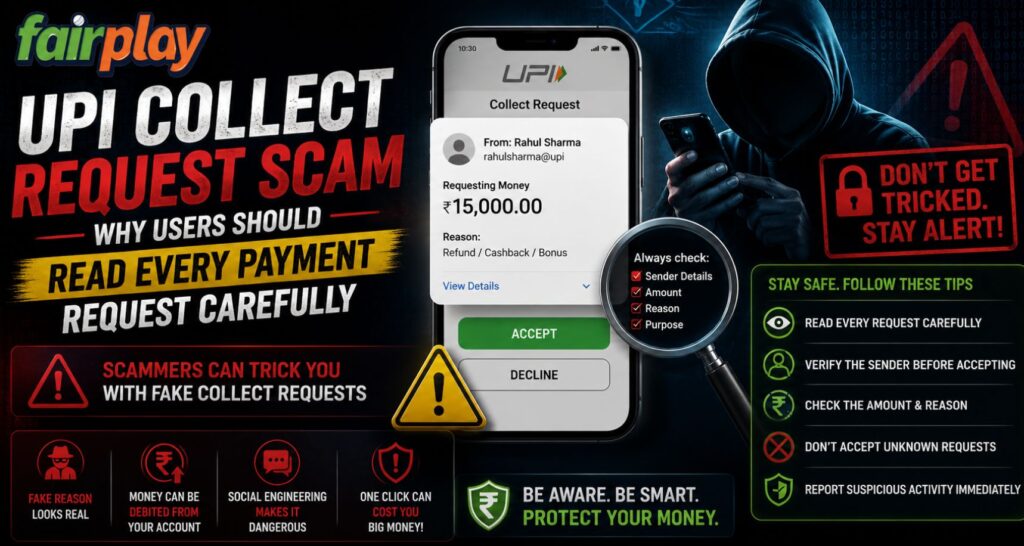
A UPI collect request is a legitimate payment feature that allows a person or merchant to request money from another UPI user.
Instead of manually entering the recipient’s UPI ID, the payer receives a request inside their payment app. If they accept the request and authorize it with their UPI PIN, money is transferred from their linked bank account.
NPCI explains that online merchants can initiate collect requests and that the customer must approve the request and enter a UPI PIN to complete the payment.
Someone accessing Fairplay24 in Login or making any online payment should therefore understand one crucial distinction: receiving a payment request does not mean money is being credited to you.
How Do Collect Request Scams Work?
Fraudsters may use social engineering to convince users that approving a collect request will result in receiving money.
A typical scam could involve someone claiming to offer:
- A refund
- Cashback
- A cancelled-order repayment
- Account verification
- Prize money
- Customer-support assistance
- Reversal of a failed payment
The scammer may then send a UPI collect request and ask the user to approve it.
The problem is simple: approving the request sends money rather than receives it.
RBI consumer guidance specifically warns users against responding to unknown “request money” instructions or suspicious payment links.
Why the UPI PIN Is an Important Warning Point
Your UPI PIN is used to authorize transactions from your account.
NPCI states that users should never share their UPI PIN and confirms that bank customer support will not ask for it.
If someone using the Fairplay24 App is told to enter a UPI PIN merely to “receive” an ordinary refund or payment, that should immediately trigger caution.
NPCI has also clarified that simply opening a UPI app does not approve a payment. The user must actively select the payment request and authorize it before the transaction is processed.
What Should You Check Before Approving a Request?
Never approve a collect request just because it appears inside a familiar UPI application.
Before proceeding, check:
- Requester’s displayed name
- Requested amount
- UPI ID
- Transaction description
- Merchant information
- Reason for the payment
- Whether you actually initiated the purchase
- Whether the amount matches what you expected
NPCI’s requirements for collect-request notifications specify that users should be shown the verified name of the requester and warned that approving the request will debit the stated amount from their account.
Fairplay24 Com users should therefore read the complete request rather than focusing only on the notification message.
Receiving Money Usually Does Not Require You to Pay First
One of the most common warning signs is being told that money can only be received after approving another transaction.
For example, a fraudster might claim:
“Approve ₹5,000 to receive your ₹5,000 refund.”
That should be treated with suspicion.
When completing a Fairplay24 in Login session or handling an unrelated payment, never assume that a collect request is required simply because someone claims money will arrive afterward.
A genuine payment request should correspond to something you knowingly agreed to pay.
Be Careful With Urgent Payment Messages
Scammers often try to create pressure.
They may say:
- “Approve within two minutes.”
- “Your refund will expire.”
- “Your account will be blocked.”
- “You must approve this verification payment.”
- “Customer support needs immediate confirmation.”
Urgency is designed to reduce the time you spend reading the payment screen.
Fairplay24 App users should ignore pressure and independently verify the request before authorizing any transfer.
What If You Receive an Unknown Collect Request?
If a request arrives unexpectedly:
- Do not approve it.
- Check the requester name and UPI ID.
- Do not enter your UPI PIN.
- Avoid calling numbers supplied in suspicious messages.
- Contact the merchant through a verified channel if necessary.
- Use your UPI application’s block or report feature where available.
BHIM, for example, provides functionality to block or mark users who send collect requests from illicit sources.
What If You Already Approved It?
If you accidentally authorize a suspicious request, act quickly.
Save the transaction ID, amount, recipient details, and screenshots. Report the transaction through your UPI app and contact your bank through its official customer-support channel.
NPCI notes that UPI grievances can be raised through participating bank UPI applications. It also states that once a payment has been initiated, it cannot simply be stopped like a conventional stop-payment request.
Fairplay Com users should never pay additional money to someone who promises to recover a previous fraudulent payment.
Final Thoughts
UPI collect requests are legitimate payment tools, but users must understand what approval actually means. A request to pay is fundamentally different from a notification that money has been received.
The safest habit is simple: verify the requester, amount, purpose, and transaction details before entering your UPI PIN. If anything seems unfamiliar, unexpected, or unnecessarily urgent, decline the request and verify it separately.
FAQs
What is a UPI collect request?
It is a request asking you to authorize a payment from your linked bank account to another user or merchant.
Does entering a UPI PIN help me receive money?
A UPI PIN is used to authorize transactions. Be suspicious if someone claims you must approve an unexpected collect request simply to receive money.
Can someone debit my account just by sending a collect request?
No. NPCI states that the user must explicitly approve the payment and authorize it for the transaction to proceed.
What should I check before approving a UPI request?
Check the requester name, UPI ID, amount, transaction purpose, and whether you knowingly initiated the payment.
What should I do with an unknown collect request?
Do not approve it. Decline or report it through your UPI app and independently verify the requester if necessary.