
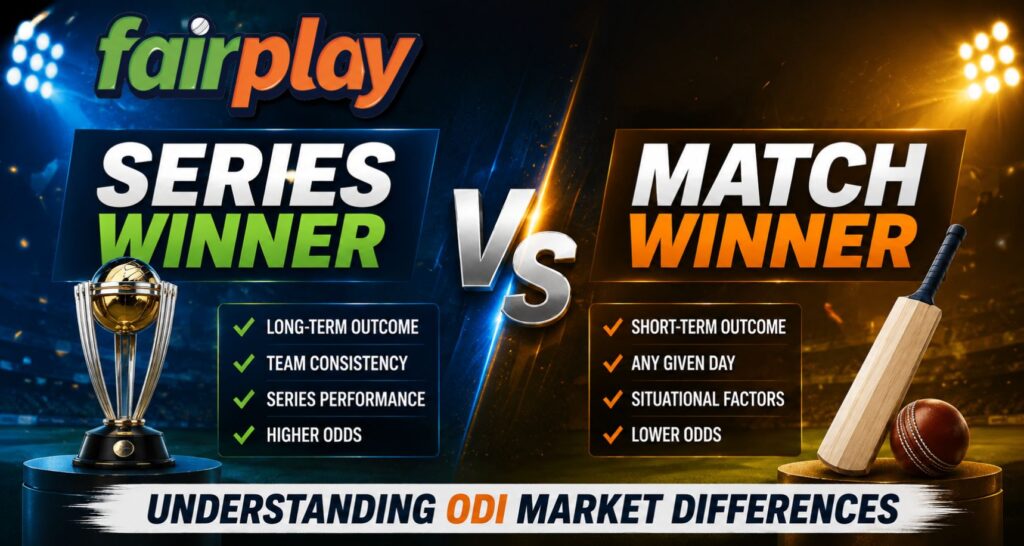
ODI cricket offers several market types, but two of the most commonly confused are Match Winner and Series Winner. For users exploring cricket markets through Fairplay24, the key difference is simple: a Match Winner market focuses on the result of one specific ODI, while a Series Winner market considers the overall outcome across multiple matches. Understanding this distinction is important because the time frame, risk factors, settlement conditions, and information influencing each market can be very different.
What Is a Match Winner Market?
A Match Winner market asks which team will win a particular ODI.
For example, if India and Sri Lanka are playing the second match of a three-game series, the market applies only to that individual fixture.
Factors that may influence a Match Winner market include:
- Playing XI
- Toss result
- Pitch conditions
- Weather
- Injuries
- Recent form
- Match venue
- Chasing conditions
After a Fairplay24 in Login, users may see prices change significantly once the toss takes place or team line-ups are officially confirmed.
The important point is that results from previous or future matches in the series do not directly decide that individual market.
What Is a Series Winner Market?
A Series Winner market looks at the result of the complete ODI series rather than one fixture.
If India and Sri Lanka play three ODIs, the team winning the majority of those matches would normally win the series.
For example:
- India wins 2-1: India wins the series.
- Sri Lanka wins 3-0: Sri Lanka wins the series.
- The series ends 1-1 with one no-result: settlement depends on the market rules.
Series Winner markets therefore remain active for much longer than Match Winner markets.
Why Can Series Winner Prices Change After Every ODI?
Each completed match changes the possible series outcomes.
Imagine a three-match series starting at 0-0.
If Team A wins the opening ODI, it moves to a 1-0 lead and needs only one more victory to secure the series. The Series Winner market may immediately react to that advantage.
Users following updates through the Fairplay24 App may see a major shift after:
- The first match result
- A key player injury
- A change of venue
- Team rotation
- Weather affecting a remaining fixture
This makes a Series Winner market more dependent on developments across several days or weeks.
Match Winner Markets React More to Immediate Conditions
A Match Winner market is generally more sensitive to information affecting that day’s contest.
The toss can be especially important.
For example, if a venue strongly favours teams batting second because of dew, winning the toss and choosing to chase could affect market expectations immediately.
Other short-term influences include:
- Sudden rain
- A star player missing the XI
- Pitch reports
- Revised targets
- Early wickets
- Required run rate
For Fairplay Com users following live cricket, Match Winner markets can therefore change quickly because they respond directly to events taking place in that game.
Series Markets Require a Longer-Term View
Series Winner markets involve more variables because several matches must be considered together.
Important factors can include:
- Squad depth
- Fitness across the series
- Rotation policies
- Different venues
- Travel schedules
- Team momentum
- Number of matches remaining
A team may lose the first ODI but still win the series if it responds strongly in the remaining games.
That is why judging a series after one match can be misleading.
What Happens If the Series Is Tied?
A tied series can create different settlement outcomes depending on the market.
Some markets may include a separate “drawn series” or “tie” selection. Others may operate according to specific settlement rules.
Before making any decision, users should check:
- Whether a tied series is a separate option
- How abandoned matches are treated
- Whether no-results count
- Whether a minimum number of matches must be completed
- Whether rescheduled fixtures remain part of the market
This is one of the most important differences between understanding the sporting result and understanding how a market is settled.
What Happens If an ODI Is Abandoned?
Abandoned or no-result matches can affect Match Winner and Series Winner markets differently.
For an individual Match Winner market, an abandoned game may be voided depending on the applicable rules and whether an official result was produced.
For a Series Winner market, the series may continue because other matches are still scheduled.
This means one abandoned fixture can reduce the number of opportunities each team has to win the overall contest.
Why Are Series Winner and Match Winner Odds Different?
The prices represent different probabilities.
A team may be strongly favoured to win one match but still face greater uncertainty across an entire series.
For example, a strong team may have:
- A good chance of winning today’s ODI
- Injured players who could miss later matches
- Poor records at upcoming venues
- Limited squad depth
These factors may make its Series Winner price less dominant than its Match Winner price.
The two markets should therefore never be compared as though they measure the same outcome.
Which Information Matters Most Before Choosing?
The useful information depends on the market.
For Match Winner:
- Confirmed playing XI
- Toss
- Weather
- Pitch
- Current form
- Venue conditions
For Series Winner:
- Full squad strength
- Remaining fixtures
- Injury outlook
- Series score
- Team depth
- Venue changes
Understanding which information matters prevents short-term factors from being overused in long-term analysis.
Conclusion
Match Winner and Series Winner markets may involve the same teams, but they measure completely different outcomes. A Match Winner market applies to one ODI, while a Series Winner market depends on results across the entire series.
Match markets are more sensitive to immediate factors such as the toss, weather, and playing XI, while series markets require a broader view of squad depth, remaining fixtures, and accumulated results. Reading the specific settlement rules is also essential, especially when matches are tied, abandoned, or affected by weather.
Frequently Asked Questions
What is the main difference between Match Winner and Series Winner?
Match Winner applies to one specific ODI, while Series Winner applies to the overall result across all matches in the series.
Can a team lose the first ODI and still win the series?
Yes. In a multi-match series, a team can recover from an early defeat and win enough remaining matches to take the series.
Does the toss affect Series Winner markets?
It can affect them indirectly by influencing individual match results, but the toss normally has a much stronger immediate impact on a Match Winner market.
What happens if an ODI is abandoned?
The Match Winner market may be voided depending on its rules, while the Series Winner market may remain active if other fixtures are still scheduled.
Can an ODI series finish tied?
Yes. If teams win the same number of completed matches, the series may finish level unless the competition rules specify another method.
Why should market rules be checked before participating?
Settlement conditions can differ for abandoned games, tied series, rescheduled fixtures, and no-results, so the exact rules determine the final outcome.