
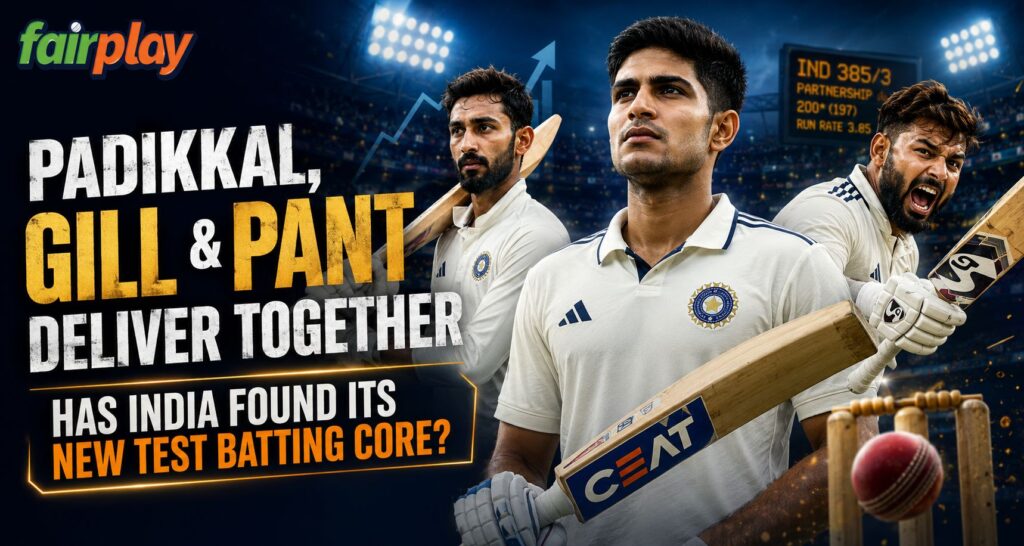
India’s Test batting is entering an important transition phase, and the first Test against Sri Lanka at Galle has offered another look at the players who could shape the order for years. For followers tracking the series through Fairplay24, Devdutt Padikkal’s maiden Test century was the standout performance, while captain Shubman Gill and Rishabh Pant remain important parts of India’s longer-term plans. The three did not all make big scores in the same innings, but their contrasting styles make the idea of a new batting core worth examining.
Padikkal Makes the Strongest Statement
Padikkal came into the Galle Test after Sai Sudharsan’s injury created an opportunity at No. 3. He responded brilliantly, scoring 167 after ending Day 1 unbeaten on 131. His innings helped India eventually post 462 in their first innings.
The score was significant because Padikkal combined patience with controlled aggression against a Sri Lankan attack increasingly relying on spin.
He had also scored a century in the warm-up match before the series, strengthening his case for a longer opportunity in the Test side.
For India, having a left-handed batter capable of occupying No. 3 could provide useful balance at the top.
Gill’s Importance Goes Beyond One Score
Gill did not produce a major score in India’s first innings, making only 16 at Galle. That means this particular Test should not be presented as a batting breakthrough for him.
His importance is broader.
For users checking match developments through Fairplay24 in Login, Gill’s performance should be assessed over a longer period because he now carries both batting and captaincy responsibilities. He won the toss and chose to bat first in Galle, leading India in the opening Test of the series.
India need Gill to provide consistency while helping a changing batting order settle around him.
Pant Gives India a Different Gear
Rishabh Pant brings a completely different style to the middle order. He scored 39 in India’s first innings after finishing the opening day unbeaten on 27.
Pant’s ability to attack spin can change the rhythm of a session quickly. Instead of allowing slow bowlers to settle into defensive lines, he often looks for scoring opportunities and forces captains to reconsider their fields.
For the Fairplay24 App audience following momentum across sessions, this aggressive option gives India something different from the more controlled approach of Padikkal or Gill.
Why Their Contrasting Styles Could Work
A strong Test batting core does not require every batter to play in the same manner. Variety can actually make a batting order more difficult to control.
Padikkal, Gill and Pant provide different strengths:
- Padikkal offers left-handed stability near the top.
- Gill provides classical strokeplay and leadership responsibility.
- Pant adds aggressive counterattacking ability.
- Their different tempos can disrupt established bowling plans.
- The combination offers both patience and acceleration.
That variety could become especially valuable when India move between spinning Asian conditions and faster overseas surfaces.
India Still Has Serious Competition for Places
India’s batting future is bigger than these three names.
KL Rahul scored 82 in the Galle first innings, while Dhruv Jurel contributed 51 as India built their 462-run total. Yashasvi Jaiswal also remains an important option at the top of the order.
That competition means India are developing a wider batting group rather than depending on a fixed trio.
For readers following analysis on Fairplay Com, the more interesting question is whether Padikkal, Gill and Pant can become central members of a broader core that also contains other established and emerging players.
What Must They Prove Next?
One successful innings or series cannot establish a long-term Test batting core.
India will need these players to demonstrate that they can:
- Score against quality spin in Asia
- Handle pace and movement overseas
- Convert good starts into centuries
- Rebuild after early wickets
- Adjust their scoring rate to match situations
- Produce runs consistently under pressure
Padikkal’s 167 is an encouraging step, but consistency across different countries and opponents will ultimately decide his place.
Gill faces the additional challenge of balancing captaincy with his batting, while Pant must continue finding the right balance between aggression and match awareness.
Could This Be India’s Next Batting Foundation?
There are certainly promising signs.
Padikkal gives India another technically strong left-handed option, Gill has the responsibility of leading the next phase, and Pant provides the attacking style capable of changing difficult situations quickly.
However, calling them India’s definitive new batting core would still be premature.
The strongest Test sides are built when talented individuals repeatedly combine to produce partnerships under different conditions. If Padikkal, Gill and Pant can do that across multiple series, India may have the foundation of an adaptable and dangerous middle order.
Conclusion
The Galle Test has strengthened Padikkal’s case more than anyone else’s, with his maiden 167 becoming one of the defining innings of India’s first-innings total. Pant added useful attacking runs, while Gill remains a major part of the bigger picture despite missing out personally.
India may not have a fully established new batting core yet, but the ingredients are becoming clearer. Consistency, overseas performances and strong partnerships will decide whether Padikkal, Gill and Pant can turn potential into a long-term Test foundation.
Frequently Asked Questions
How many runs did Devdutt Padikkal score at Galle?
Padikkal scored 167 in India’s first innings, recording his maiden Test century.
What did Rishabh Pant score in the first innings?
Pant scored 39 before becoming debutant Keshara Nuwantha’s first Test wicket.
How many runs did Shubman Gill score?
Gill scored 16 in India’s first innings at Galle.
Can Padikkal, Gill and Pant already be called India’s new Test core?
They have the qualities to form an important part of it, but consistent performances across multiple series and different conditions will be needed before that status is firmly established.