
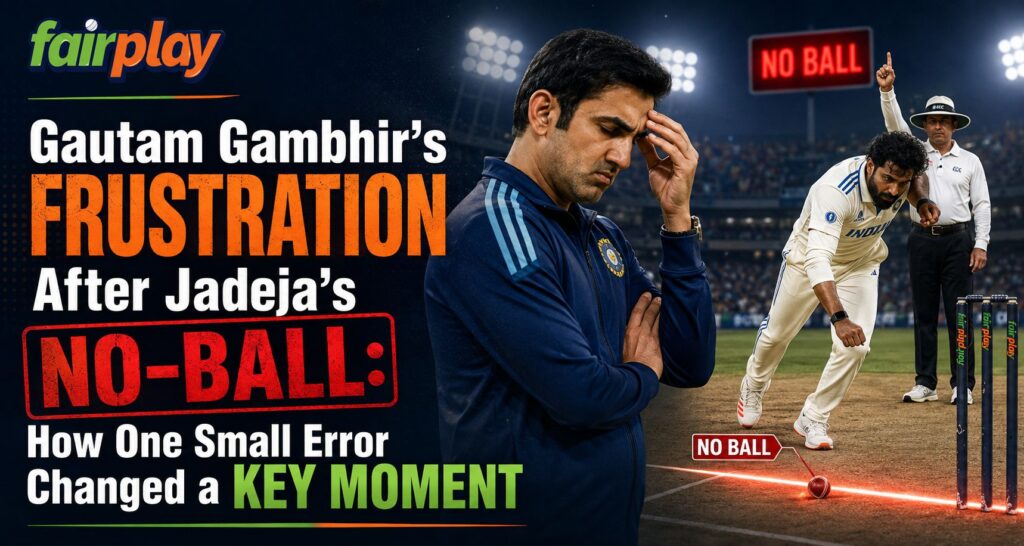
Test cricket can turn on details that last only a few seconds. India experienced that on Day 4 of the first Test against Sri Lanka in Galle when Ravindra Jadeja appeared to dismiss Dhananjaya de Silva, only for the delivery to be called a no-ball. For Fairplay24 readers, Gautam Gambhir’s visible frustration summed up the mistake: India had created a chance against Sri Lanka’s captain, but an overstep erased the wicket.
What Happened With Jadeja’s No-Ball?
During Sri Lanka’s fourth-innings chase of 372, Jadeja produced a sharply turning delivery that took the edge of Dhananjaya’s bat. KL Rahul completed the catch at first slip, but the celebration ended when Jadeja was ruled to have overstepped.
Gambhir was visibly disappointed because Dhananjaya was one of Sri Lanka’s key remaining batters.
Fans checking Fairplay24 in Login updates saw what looked like a major breakthrough disappear instantly.
Why Was Dhananjaya Not Out?
Cricket’s no-ball law requires a bowler’s front foot to land with some part behind the popping crease. If that condition is not met, the delivery is illegal.
A batter cannot be dismissed caught from a no-ball. Once Jadeja’s overstep was confirmed, Rahul’s catch could not count.
For Fairplay24 App users learning match rules, the moment is a reminder that the quality of a delivery does not override the legality of the bowler’s landing.
Why the Timing Made the Error Costly
Sri Lanka were chasing a demanding target, so losing their captain could have exposed another batter immediately.
India still reduced Sri Lanka to 84 for 4 by stumps, but Dhananjaya remained unbeaten on 31 alongside Sonal Dinusha on 25. The batter who had been reprieved was therefore still at the crease when play ended.
For Fairplay24 Com followers, this shows why a no-ball can mean much more than one extra run. When it cancels a wicket, it can change pressure and tactical plans.
How One Small Error Changes Momentum
A wicket in a fourth-innings chase can create immediate pressure. Had Dhananjaya been dismissed, India could have attacked a new batter on a wearing Galle surface. Instead, Sri Lanka’s captain received another opportunity.
The no-ball changed the moment in several ways:
- India lost a potential wicket.
- Dhananjaya received an important reprieve.
- A new batter was not exposed immediately.
- India had to rebuild pressure.
- Jadeja had to reset.
A Fairplay24 Login follower looking only at the extra run would miss the larger tactical cost.
Why the Error Stood Out
Spinners generally use shorter run-ups than fast bowlers, so front-foot no-balls can seem particularly avoidable. Small changes in rhythm or stride length can still cause an overstep.
What made Jadeja’s mistake more frustrating was that the delivery itself worked perfectly. It turned, found the edge and produced a catch.
For Fairplay24 App readers, Jadeja’s skill created the opportunity, while his foot placement removed the reward.
Gambhir’s Reaction Reflected India’s Position
India had set Sri Lanka 372, so every wicket strengthened their grip on the final day. Gambhir’s reaction reflected the value of the missed opportunity rather than proving the match had suddenly turned.
The episode also showed why teams focus on controllable errors. A brilliant shot from a batter is difficult to prevent, while a front-foot no-ball is something a bowler can work to eliminate.
Fairplay24 Com users can therefore view the incident as a lesson in execution under pressure.
India Responded Well
India did not allow the no-ball to derail the session. Mohammed Siraj, Manav Suthar and Prasidh Krishna helped reduce Sri Lanka to four wickets down before stumps.
The wider lessons were:
- Maintain front-foot discipline.
- Reset quickly after mistakes.
- Keep attacking after missed chances.
- Avoid letting frustration affect the next delivery.
- Judge an error in its match context.
Conclusion
Jadeja’s no-ball did not decide the Test, but it changed a key passage. A delivery good enough to dismiss Dhananjaya became a reprieve because of one overstep, and Sri Lanka’s captain survived to stumps.
For Fairplay readers, Gambhir’s frustration showed how narrow the margins can be in Test cricket. When a team is hunting fourth-innings wickets, a few centimetres at the crease can separate a major breakthrough from a second chance.
FAQs
Who survived because of Jadeja’s no-ball?
Dhananjaya de Silva survived after edging Jadeja to KL Rahul at first slip.
Why did the catch not count?
Jadeja had overstepped, making the delivery a no-ball, so the caught dismissal could not stand.
How did Gautam Gambhir react?
The India head coach was visibly frustrated after the wicket was cancelled.
What was Sri Lanka’s score at stumps?
Sri Lanka finished Day 4 on 84 for 4 while chasing 372.
Why was the no-ball important?
It cancelled the dismissal of Sri Lanka’s captain and prevented India from immediately attacking a new batter.